

|
Quantity
|
Out of stock
|
||
|
|
|||
|
|
|||
Hiking Overboots — Additional Insulation and Footwear Protection in Cold Conditions
Keeping your feet protected in the mountains is not always simply a matter of buying warmer boots. Footwear for a summer hike in the Carpathians, winter trekking, and a high-altitude ascent needs to meet very different requirements in terms of insulation, weight, and construction.
In theory, you could have a separate pair of boots for every situation: lightweight trekking boots for the approach to base camp, warm mountaineering boots for snow and freezing temperatures, and double high-altitude boots for demanding ascents. In practice, however, this means carrying additional weight and bulk.
The situation becomes even more complicated when conditions change significantly during a single trip. You may begin by following rainy trails at 3,000 m, enter a snowy zone at 6,000 m, and then continue climbing to 7,000 m or higher.
Walking the entire route in heavy high-altitude boots is uncomfortable, while carrying several pairs of footwear is impractical.
This is where hiking overboots become useful. They allow you to add protection from snow, wind, and cold exactly when you need it.
What Are Hiking Overboots?
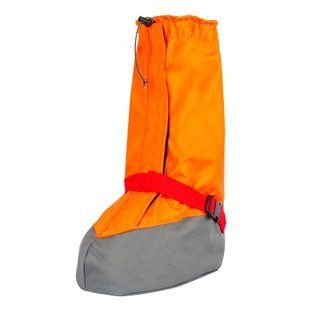
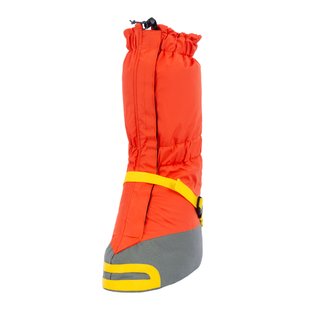
Unlike regular hiking gaiters, which primarily cover the lower leg and the top of the boot, overboots for hiking cover a much larger part of the footwear itself.
Their purpose is to create an additional protective layer around the boot.
Depending on their construction, overboots can provide:
-
additional insulation;
-
snow protection;
-
wind protection;
-
an additional barrier against external moisture;
-
extra protection for footwear in demanding winter conditions.
Insulated overboots become particularly useful during winter hiking and at high altitude, where regular trekking or mountaineering boots may no longer provide sufficient warmth.
Why Use Overboots in the Mountains?
The main advantage of overboots is their ability to adapt your footwear system to changing conditions.
For example, you can complete part of the route in your regular trekking or mountaineering boots. When temperatures drop, deep snow begins, or you reach higher elevations, overboots can be added on top.
This means you do not necessarily have to wear your heaviest and warmest footwear throughout the entire journey.
This approach is particularly practical on routes with significant elevation changes.
During the approach, low weight and comfortable movement are priorities. Higher up, protection from snow and cold weather becomes increasingly important. During a high-altitude ascent, insulation requirements increase even further.
Overboots allow you to adapt your footwear system gradually as these conditions change.
Overboots for Winter Hiking
For winter hiking, overboots can provide an additional protective layer over trekking or mountaineering footwear.
They are particularly useful on routes with deep or wet snow, strong winds, and prolonged exposure to low temperatures.
For example, during spring trips in the Carpathians, the lower part of a route may follow almost completely dry trails, while higher elevations can still have deep, wet snow. In this situation, you do not necessarily need to wear overboots all day. They can be carried as an additional piece of equipment and put on when conditions require extra protection.
During winter trips along the Chornohora Ridge or other exposed mountain routes, additional foot insulation may be useful for a significant part of the journey.
Overboots for High-Altitude Ascents
The higher you climb, the more difficult it becomes to keep your feet comfortably warm.
During high-altitude ascents, low temperatures are combined with strong winds, prolonged exposure to snow and ice, a slower pace of movement, and long stops.
Footwear that performed perfectly well during the approach may no longer provide enough insulation higher on the mountain.
This is why outdoor overboots can be used as part of a modular system: your main boots are worn at lower elevations, while overboots are added when you enter colder conditions.
This approach can be particularly practical on expeditions where you pass through several climate and altitude zones during a single trip.
However, overboots cannot automatically transform any pair of trekking boots into footwear suitable for extreme altitude. For serious high-altitude mountaineering, the entire footwear system must be appropriate for the expected temperatures, route difficulty, and technical equipment.
Overboots and Insulated Liners
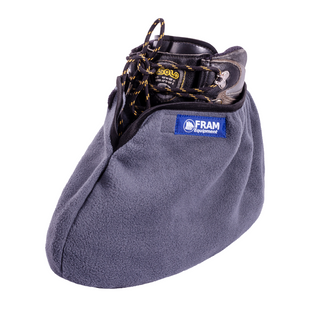
The system can be expanded further with insulated liners — an additional inner insulating layer used together with the outer overboots.
Each part of this system performs a different function.
The outer overboot primarily protects against snow, wind, and external moisture, while the inner liner provides additional thermal insulation.
This makes it possible to adjust the level of warmth according to the conditions.
In relatively mild weather, the outer overboots may be sufficient on their own. When temperatures drop significantly or the route reaches higher elevations, an additional insulating liner can be added.
This modular approach is particularly useful for long winter trips and expeditions where temperature and altitude vary considerably throughout the route.
Materials Used for Hiking Overboots
Overboot materials need to meet demanding requirements. They must protect against the weather while also withstanding contact with snow, ice, rocks, and technical equipment.
For this reason, membrane fabrics and durable abrasion-resistant materials such as Cordura® are commonly used in their construction.
Membrane Fabrics
Membrane materials are particularly useful in the upper sections of overboots, where protection from snow, wind, and moisture is important.
A membrane creates a barrier against external water while providing a certain level of breathability.
This matters because your feet still produce moisture during active movement, even in cold weather. If the entire footwear system has very limited moisture transfer, condensation can accumulate inside.
When choosing overboots, it is therefore important to consider not only insulation but also how the complete footwear system manages moisture.
Cordura®
The lower part of an overboot operates in much harsher conditions.
It may come into contact with rocks, ice, snow, crampons, ski bindings, and other pieces of equipment.
Resistance to abrasion and mechanical damage is therefore particularly important in this area.
Cordura® is well suited to these high-wear zones because of its durability and abrasion resistance.
Combining membrane fabrics with Cordura® reinforcements makes it possible to balance weather protection, weight, and durability.
Overboots and Crampons
For winter climbing and mountaineering, compatibility between overboots and crampons is especially important.
An overboot should not interfere with the correct attachment of the crampon to the boot, cover critical attachment points, or make the fit unstable.
At the same time, the lower part of the overboot needs to be sufficiently durable because sharp crampon points can damage the fabric if you accidentally catch it while moving.
For technical routes, choosing the correct overboot size, ensuring a secure fit over your particular boots, and reinforcing areas vulnerable to mechanical damage are especially important.
Before a demanding trip, the complete boot + overboot + crampon system should always be tested together.
Using Overboots with Skis and Snowshoes
Overboots are not limited to hiking and climbing.
They can also be useful for winter travel with skis and snowshoes, where your feet remain close to snow for many hours.
Overboots help prevent snow from entering around the upper part of the footwear while creating an additional barrier against cold and wind.
As with crampons, however, compatibility with the entire system needs to be checked in advance.
Ski or snowshoe bindings should not damage the fabric, excessively compress the overboots, or interfere with their correct fit.
Overboots for Bivouacs
Another important use case is a bivouac in cold weather.
While you are moving, your body generates a considerable amount of heat. Once you stop, heat production decreases rapidly, and the extremities can become cold particularly quickly.
An additional insulating layer around your footwear can help reduce heat loss while spending time at camp.
Depending on their construction and the particular system, overboots combined with insulated liners can provide additional warmth during rest stops and while staying at base camp or high-altitude camps.
For winter and high-altitude travel, this is another advantage of a modular system: extra insulation can be added precisely when your activity level decreases.
How to Choose Hiking Overboots
Instead of starting with the question, “Which overboots are the warmest?”, begin by considering the conditions of your route.
For winter hiking, assess the expected temperatures, amount and type of snow, duration of the route, and characteristics of your primary footwear.
For high-altitude ascents, consider not only the absolute temperature but also elevation, wind, duration of exposure to cold conditions, and your expected pace of movement.
If the route involves significant temperature changes, a modular boots + overboots + insulated liners system provides greater flexibility in adjusting the level of insulation.
Also consider:
-
compatibility with the size and shape of your boots;
-
level of insulation;
-
snow and moisture protection;
-
durability of the lower section;
-
Cordura® reinforcements;
-
membrane properties;
-
compatibility with insulated liners;
-
compatibility with crampons;
-
compatibility with skis and snowshoes;
-
packed weight and volume.
Overboots as Part of a Modular Cold-Weather System
The main advantage of hiking overboots is that additional protection and insulation can be added exactly when they are needed.
You do not necessarily need to complete an entire route in heavy high-altitude boots simply because several days of the expedition will involve extremely cold conditions. Nor is it always practical to carry a separate pair of boots for every altitude zone.
Properly selected overboots for hiking can make your footwear system more adaptable.
On a winter route, they provide additional protection from snow and cold weather. At a bivouac, they can help reduce heat loss during long stops. On a high-altitude ascent, they provide an additional level of insulation when your primary footwear alone is no longer sufficient.
Combining outer overboots with insulated inner liners makes it possible to adapt the system even more precisely to the temperature, altitude, and specific stage of your journey.