


|
Quantity
|
Out of stock
|
||
|
|
|||
|
|
|||
Tents and Group Shelters — Shelter for Hiking, Expeditions, and Team Travel
A tent is one of the most important pieces of outdoor equipment, directly affecting comfort, safety, and self-sufficiency during any trip. Different types of shelters are designed for different outdoor activities — from compact ultralight tents for solo hiking to spacious group shelters for large trekking teams and expeditions.
Modern hiking tents and group shelters are designed with careful attention to weight, weather resistance, wind stability, and ease of use in the field. For multi-day hiking, mountaineering, and expeditions, the ideal shelter provides the right balance between durability and pack weight.
Types of Hiking Tents
The most common tents for hiking differ in purpose, weight, and construction.
Trekking Tents
The most versatile option for the majority of hiking trips.
Advantages:
-
excellent balance between weight and durability;
-
protection from rain and wind;
-
easy setup;
-
compact packed size.
They are well suited for mountain hiking, trekking, backpacking, bikepacking, and most multi-day routes.
Expedition Tents
Designed for severe weather, expeditions, high-altitude mountaineering, and winter conditions.
Advantages:
-
exceptional wind resistance;
-
strong pole structures;
-
reliable snow protection;
-
durability in harsh alpine environments.
An expedition tent is the preferred shelter for alpine expeditions, high camps, and demanding winter mountaineering routes.
Ultralight Tents
When every gram matters, ultralight hiking tents become the best choice.
Their main advantages are:
-
extremely low weight;
-
very compact packed size;
-
fast setup;
-
easy transportation over long distances.
Ultralight tents are especially valuable during long self-supported trips, thru-hiking, alpine approaches, and expeditions where a fully loaded backpack must be carried for many days.
What Is a Group Shelter?
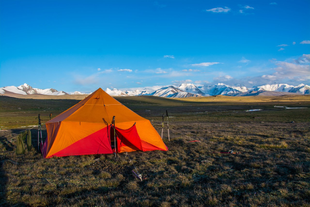
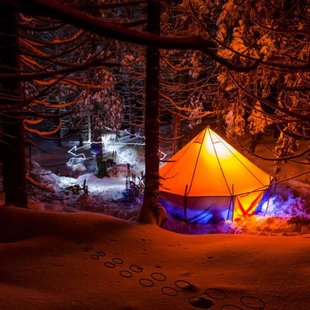
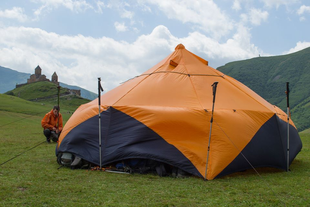
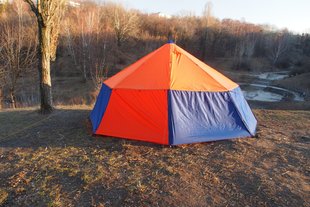
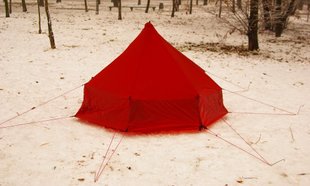
A group shelter is a spacious communal shelter that combines the functions of a tent, a common living area, and a team gathering space.
Unlike a standard hiking tent, a group shelter is designed to accommodate several people at the same time, making it particularly valuable for:
-
expeditions;
-
winter hiking;
-
high-altitude mountaineering;
-
guided trekking groups;
-
outdoor training courses;
-
team travel and base camps.
A group shelter creates a shared space where the entire team can gather regardless of weather conditions.
Advantages of Group Shelters for Teams
A Shared Space for the Entire Group
One of the greatest strengths of a group shelter is the ability to bring the entire team together in a single protected space.
Inside a group shelter you can:
-
cook meals;
-
rest;
-
hold briefings;
-
discuss route plans;
-
dry equipment;
-
wait out storms and bad weather.
This is especially valuable during expeditions, winter trips, high-altitude climbs, and guided group travel where communication and team coordination are essential.
Excellent Weight-to-Capacity Ratio
Modern group shelters offer one of the best weight-to-capacity ratios among large outdoor shelters.
For example, a warm double-wall shelter weighing approximately 5.5 kg can accommodate 7-8 people, making it an extremely efficient option for larger teams.
This allows:
-
weight to be distributed among multiple participants;
-
lower pack weight for each individual;
-
significant savings during long self-supported expeditions;
-
reduced transportation costs in porter-supported expeditions.
High Wind Resistance and Reliability
A well-designed expedition shelter is engineered for demanding mountain conditions.
A central support pole, reinforced structural seams, and a robust guyline system provide:
-
excellent wind resistance;
-
strong snow-load performance;
-
stability during severe storms;
-
reliable use at high altitude.
Such shelters have proven effective during winter expeditions and high-mountain mountaineering in harsh weather.
Efficient Use of Campsite Space
Although a group shelter appears much larger than a standard tent, it often requires surprisingly little additional campsite area compared with several smaller tents of equivalent total capacity.
Advantages include:
-
highly efficient living space;
-
room for backpacks and equipment inside;
-
easy movement within the shelter;
-
reduced need for multiple vestibules.
On snow-covered terrain, campsite preparation is also faster because the work is shared by the entire group.
Superior Livability
One of the most noticeable advantages of a group shelter is its exceptional livability.
The generous interior volume allows you to:
-
sit comfortably;
-
change clothing more easily;
-
cook inside the shelter;
-
organize equipment efficiently;
-
spend extended periods indoors during bad weather.
During expeditions, a group shelter often becomes the communal living area where the entire team gathers.
Warmth in Cold Conditions
Despite its larger volume, a group shelter is often warmer than several small individual tents.
This is due to:
-
the heat generated by multiple occupants;
-
improved heat retention;
-
the ability to use a gas lantern;
-
compatibility with portable expedition stoves.
For this reason, group shelters are especially valuable during winter hiking and cold-weather expeditions.
Modular Design
Many modern group shelters feature modular construction, greatly increasing their versatility.
Useful features include:
-
removable floors;
-
the ability to pitch only the outer shelter;
-
use as a large rain or sun shelter;
-
spacious storage areas between the outer fly and inner shelter.
This modularity allows a single shelter to adapt to a wide variety of weather conditions and expedition scenarios.
What Should You Look for When Choosing a Tent or Group Shelter?
Before buying a hiking tent or group shelter, consider the type of trips you plan to undertake.
The most important factors are:
-
number of users;
-
season of use;
-
total weight;
-
wind resistance;
-
waterproof performance;
-
interior capacity;
-
ease of setup;
-
packed size.
For solo travel and lightweight trekking, ultralight tents are usually the best option.
For multi-day hiking with a small group, a quality trekking tent provides the best balance of comfort and weight.
For expeditions, winter routes, and larger teams, a spacious group shelter is often the most effective solution.
How to Choose the Right Shelter
For lightweight hiking and long-distance backpacking, choose an ultralight hiking tent.
For severe mountain weather, select a durable expedition tent with excellent wind resistance.
For teams, clubs, guiding operations, training groups, and expedition base camps, a group shelter offers significant advantages through shared living space, excellent weight efficiency, high reliability, and outstanding comfort in difficult weather conditions.
That is why hiking tents, tents for hiking, expedition tents, and modern group shelters remain some of the most important pieces of outdoor equipment for camping, trekking, multi-day hiking, and large-scale mountain expeditions.