




|
Quantity
|
Out of stock
|
||
|
|
|||
|
|
|||
Insulated Outdoor Clothing — Warmth for Winter Hiking and High-Altitude Ascents
In winter mountains, reliable insulation is much more than a matter of comfort. Low temperatures, strong winds, long stops, and prolonged exposure at high altitude create conditions in which the body can lose heat much faster than during an ordinary hike.
Insulated outdoor clothing becomes especially important when the intensity of movement decreases. While actively gaining elevation with a backpack, your body generates plenty of heat. But as soon as you stop for a break, belay a partner, set up a bivouac, or simply slow down, the need for additional thermal insulation increases rapidly.
That is why warm hiking clothing is an essential part of your equipment for winter hiking, mountaineering, mountain trekking, and high-altitude ascents.
Why Is Reliable Insulation Especially Important at High Altitude?
The more demanding the conditions, the more important it is to have an insulating layer you can rely on.
During high-altitude ascents, low temperatures are combined with strong winds, snow, and prolonged exposure on open terrain. At the same time, the body is working with less available oxygen, while the pace of movement often becomes slower.
In these conditions, clothing needs to help minimize heat loss both while moving and during unavoidable stops.
For challenging winter routes, the solution is therefore not simply one extremely warm garment but a carefully planned layering system. The base layer manages moisture, the mid layer provides additional insulation, the outer layer protects against wind and precipitation, while insulated clothing for hiking adds significantly more thermal protection when conditions require it.
Synthetic Insulation in Outdoor Clothing
Synthetic insulation is one of the most common solutions used in winter outdoor clothing.
Its structure traps air within the insulating material. This trapped air creates a thermal barrier that helps reduce heat loss.
For outdoor clothing, finding the right balance between three characteristics is particularly important: thermal insulation, weight, and packability.
Increasing the amount of insulation can make a garment warmer, but it also increases its weight and packed volume. This matters in mountain environments, where all clothing and equipment must be carried with you.
Good winter outdoor clothing therefore needs to provide an appropriate level of warmth for its intended conditions without unnecessary weight and bulk.
Another important advantage of synthetic insulation is its practicality in changeable outdoor environments. It is used in garments designed for cold weather, snow, high levels of physical activity, and conditions where completely avoiding contact with moisture can be difficult.
Thinsulate™ Insulation
Thinsulate™ is a synthetic insulation made with fine fibers and designed to provide effective thermal insulation without adding excessive bulk.
A large number of fine fibers helps trap air within the insulating layer. This makes it possible to create relatively compact garments and accessories, which is particularly useful when excess bulk could interfere with movement.
Thinsulate™ is used in various types of winter clothing, footwear, and accessories.
For outdoor activities, it is especially practical when warmth needs to be combined with low bulk — for example, in gloves and other pieces of equipment that need to remain functional in cold weather.
The actual level of thermal insulation depends on the particular type of Thinsulate™, its weight and thickness, the amount of insulation used, and the overall construction of the product.
Termoloft® Insulation
Termoloft® is a synthetic insulation used in warm outdoor clothing to create an effective thermal layer.
Its purpose is to trap air within the structure of the material, helping to reduce heat loss.
For outdoor equipment, synthetic insulation makes it possible to create warm garments designed to achieve a balance between thermal efficiency, low weight, and packability.
Termoloft® can be used in insulated jackets, pants, and other garments designed for cold conditions.
As with other types of insulation, the actual warmth of the finished garment depends not only on Termoloft® itself but also on the amount and distribution of insulation, garment construction, outer fabric, and overall design.
Insulated Jackets
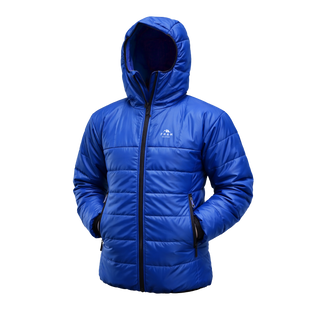
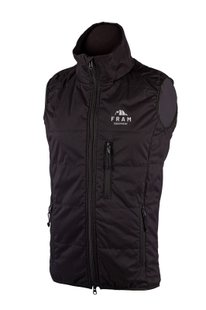
An insulated jacket is one of the most important pieces of clothing for cold-weather activities.
During a winter hike, it can be used during rest stops, in the evening at a bivouac, around camp, and in other situations when the intensity of movement decreases and the body begins to generate less heat.
In high-altitude mountaineering, the role of an insulated jacket becomes even more important. At higher elevations, it may be needed not only while resting but also while moving.
When choosing an insulated hiking jacket, consider:
-
the level of thermal insulation appropriate for the expected temperatures and route;
-
the type and amount of insulation;
-
overall jacket weight;
-
packed size;
-
protection from wind;
-
hood construction;
-
a fit that works within a layering system;
-
pocket placement and accessibility when using other equipment.
For mountain trekking, the balance between warmth and weight is particularly important. The warmest jacket is not necessarily the best choice: its characteristics should match the temperature, altitude, duration of the route, and expected level of activity.
Insulated Full-Zip Pants
Adding insulation to your upper body is relatively easy — you can simply put a warm jacket over your existing layers. Adding insulation to your legs can be more complicated. With conventional insulated pants, you may need to remove your footwear and some of your equipment before putting them on.
In the mountains, this can be inconvenient and sometimes impractical.
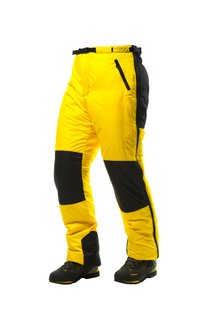
This is exactly the problem that insulated full-zip pants are designed to solve.
Their key feature is a construction with long side zippers that allows the pants to be quickly put on over your existing clothing without removing hiking or mountaineering boots.
This makes it possible to add insulation directly on the route whenever conditions change.
Insulated full-zip pants are particularly useful:
-
during rest stops;
-
at a bivouac;
-
around a cold camp;
-
during long periods of belaying;
-
on high-altitude ascents;
-
during winter hiking;
-
for ski touring and other winter activities.
One of the biggest advantages of this design is speed. When you stop after intensive movement, there is no need to wait until you start feeling cold — an additional insulating layer can be put on immediately.
Insulated Full-Zip Pants for High-Altitude Ascents
During high-altitude ascents, insulated pants can change from an optional extra layer into one of the primary components of your clothing system.
At high elevations, low temperatures, strong winds, and a slower pace of movement significantly increase the need to keep the legs insulated.
In these conditions, low weight, effective thermal insulation, and freedom of movement become especially important.
A full-zip construction also makes it easier to adapt your layering system to changing conditions: quickly add insulation when it gets colder and remove it just as quickly when temperatures rise or the intensity of movement increases.
Insulated Clothing for Rest Stops and Bivouacs
One of the most important times to use warm clothing is when transitioning from active movement to rest.
While climbing uphill, the body generates a large amount of heat. Once you stop, heat production drops rapidly, while wind and cold air continue to cool the body.
This is why it is better to put on an insulating layer during a rest stop before you become significantly chilled.
At a bivouac, warm clothing becomes part of the overall cold-weather protection system. An insulated jacket and pants make it more comfortable to prepare food, set up camp, organize equipment, and spend time outside your sleeping bag.
This is particularly important on winter routes, where a significant part of the day may be spent in low temperatures even after active movement has ended.
How to Choose Insulated Outdoor Clothing
Instead of starting with the question, “What is the warmest clothing?”, consider the conditions in which you actually plan to use it.
For winter hiking, consider the expected temperatures, wind conditions, duration of the route, and how much time you are likely to spend without active movement.
For mountain trekking, the balance between insulation, weight, and packability is especially important because all of your equipment needs to be carried in your backpack.
For rest stops and bivouacs, clothing that can be quickly put on over your existing layers is particularly practical.
For high-altitude ascents, insulation requirements increase significantly, and an insulated jacket and pants may need to be worn while moving as well as during stops.
It is also important to consider the complete clothing system. Even a very warm jacket does not work in isolation: a base layer manages moisture, intermediate layers help retain warmth, the insulated layer provides additional thermal protection, and when necessary, an outer shell or membrane clothing protects the entire system from wind and precipitation.
Insulated outdoor clothing is essential whenever low temperatures become one of the defining factors of your route. Insulated jackets and full-zip pants make it easier to adapt your clothing system to cold weather, winter hiking, bivouacs, rest stops, and high-altitude ascents, while modern synthetic insulation makes it possible to combine effective thermal insulation with the low weight and packability that matter in the outdoors.