The Piolets d’Or is one of the most recognized international awards in the world of alpinism. Every year, it highlights some of the most significant climbs and new routes, offering a snapshot of where high level mountaineering is heading.
The 2026 edition once again showed that modern alpinism is about much more than the height of a summit or the reputation of the climbers. This year’s award winning climbs span the Himalayas, Karakoram and Andes, and share several defining qualities: huge scale, technical difficulty, autonomy, and a commitment to climbing a mountain as a complete route, from ascent to descent.
At Fram Equipment, we have been connected to both Ukrainian Piolets d’Or distinctions and follow developments in international alpinism every year. We’ve previously shared stories about remarkable ascents of Annapurna III and Talung on our blog. This time, we decided to take a broader look at the Piolets d’Or 2026.
Not only at who received the Golden Ice Axes, but also at what these ascents, completed in 2025, can tell us about modern alpinism.
The Piolets d’Or 2026 winners
Four climbs received this year’s awards.
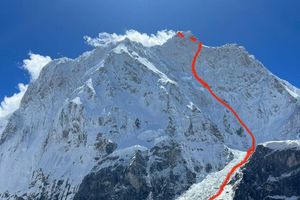
Jannu East, 7,460 m, Nepal
Route: Le Sommet des Pieux, 2,300 m, M6 WI5, via the north face and east ridge.
Climbers: Nicolas Jean and Benjamin Védrines, France.
The team climbed a highly technical route on one of the Himalayas’ most iconic seven thousand metre peaks, combining a major vertical gain with demanding mixed climbing.
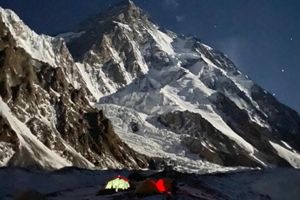
Ultar Sar, 7,388 m, Pakistan
Route: Shooting the Moon, 3,100 m, M5 WI4, via the southeast buttress.
Climbers: Ethan Berman, Maarten van Haeren and Sebastián Pelletti.
With 3,100 metres of climbing, this was one of the longest routes among this year’s winners. The team completed a sustained and technically demanding line in the Karakoram in a fully autonomous style.
Aikache Chhok, 6,673 m, Pakistan
Route: Secrets, Shepherds, Sex and Serendipity, 3,000 m, M7 A2+ AI5, via the northwest face with a complete summit traverse.
Climbers: George Ponsonby and James Price.
The defining feature of this ascent was not only the route itself, but the complete traverse of the massif. Instead of descending by the same line, the climbers continued across the summit and into unknown terrain on the other side.
Yerupajá Grande, 6,634 m, Peru
Route: The Essence of Commitment, 1,400 m, 6c+ M6+ WI5, up to 95°, via the east buttress and east ridge, traversing to Yerupajá Sur and descending the southeast face.
Climbers: Bru Busom, Rubén Sanmartín and Marc Toralles.
The only winning ascent from South America this year, this route in the Cordillera Huayhuash demonstrates that absolute altitude is only one part of the equation. Its technical difficulty and complex terrain make it a serious high altitude challenge despite its lower summit elevation.
Big walls over short technical routes
One of the most noticeable trends in this year’s Piolets d’Or is the importance of scale.
The longlist included many extremely technical routes on peaks between 5,000 and 6,000 metres, including lines involving difficult rock climbing, aid climbing and technical mixed terrain.
However, the final four winners were largely defined by enormous vertical scale:
Ultar Sar: 3,100 m
Aikache Chhok: 3,000 m
Jannu East: 2,300 m
Yerupajá Grande: 1,400 m
This highlights an important aspect of modern alpinism. Difficulty is not determined only by the hardest pitch of a route. It also depends on how long a team can sustain a high level of technical difficulty while dealing with altitude, cold, changing weather and limited resources.
One extremely difficult pitch and several kilometres of sustained technical climbing represent very different challenges.
The aesthetics of the traverse
Another characteristic of this year’s climbs is the importance of how a mountain is climbed, not simply whether the summit is reached.
On Aikache Chhok, the climbers completed a full traverse of the massif, ascending from one side and continuing across the summit towards the opposite side.
At high altitude, this is more than an aesthetically pleasing line on a map. Descending through unknown terrain introduces additional uncertainty and requires the team to make decisions without having prior information about the route.
On Jannu East and Ultar Sar, descending by the ascent line was largely dictated by the isolation and complexity of the terrain.
This reflects a broader principle of modern alpine style: the ascent, summit and descent increasingly form one continuous story rather than three separate stages of an expedition.
The Karakoram takes centre stage
The geographical distribution of this year’s awards is also notable.
Two of the four winning climbs, Ultar Sar and Aikache Chhok, are located in Pakistan. Another is in the Nepalese Himalayas, while the fourth is in the Peruvian Andes.
The wider longlist, however, represented a much broader range of mountain regions, including the Pamirs, Tien Shan, Caucasus and several Chinese ranges.
The Karakoram stands out in particular.
The region has long attracted climbers with its huge faces, difficult approaches, unstable weather and large number of relatively unexplored lines.
This year, it effectively became one of the main centres of attention at the Piolets d’Or.
Reputation does not replace the climb
The 2026 longlist included some of the best known names in international alpinism, including Denis Urubko, Arve Barmaas, Adam Bielecki, Nives Meroi, Romano Benet and Thomas Huber.
Yet the final four awards demonstrate that name recognition alone does not determine the outcome.
Benjamin Védrines is already a highly recognized figure in international alpinism, but the other winning teams include climbers with considerably less media visibility.
Ethan Berman, Maarten van Haeren and Sebastián Pelletti, George Ponsonby and James Price, and Bru Busom, Rubén Sanmartín and Marc Toralles all received recognition for the quality of their climbs.
This reinforces one of the central ideas behind the award: the climb itself remains the key factor. Its difficulty, style, scale and execution matter more than the reputation of the people behind it.
Why did Yerupajá Grande make the cut?
Compared with the enormous Himalayan and Karakoram walls, Yerupajá Grande may initially seem like a less obvious candidate.
Its summit stands at 6,634 metres and the route has 1,400 metres of vertical gain, while the other three winning climbs exceed 2,000 metres.
But altitude and length are far from the only ways to measure difficulty.
The Essence of Commitment follows the east buttress and ridge, with difficulties including 6c+, M6+, WI5 and sections reaching 95 degrees.
The terrain of the Cordillera Huayhuash is characterised by complex snow and ice formations, steep sections and unstable structures. As a result, 1,400 metres of this type of terrain can represent a completely different challenge from 1,400 metres of easier high altitude climbing.
It is a good example of why modern alpinism cannot be evaluated by summit elevation alone.
What the longlist tells us about 2026
The four winning climbs are only part of the picture. Looking at the wider Piolets d’Or longlist reveals several additional trends.
Ultralight style and paragliding
One of the most interesting developments is the combination of fast alpine style with paragliding.
The ascent of Anidesh Chuli by Nicolas Jean and Benjamin Védrines, followed by a paraglider descent, demonstrates how paragliding can become integrated into the overall strategy of a high altitude climb.
Rather than being a separate activity, it can serve as a tool for reducing descent time and potentially limiting the amount of time a team spends in exposed terrain.
International teams
Another clear trend is the growing number of international partnerships.
The longlist includes teams bringing together climbers from different countries and alpine traditions. Polish climbers are working with Slovak and Italian partners, Canadians are joining forces with climbers from other national schools, and European teams are travelling to Asia to tackle technically demanding objectives together.
This makes sense for modern alpinism. Difficult routes increasingly require a combination of technical skills, experience and knowledge of different types of terrain.
The strength of Eastern European alpinism
The longlist also highlights the continued strength of Eastern European climbing schools.
Georgian climbers remain active on demanding mixed routes in the Caucasus and Hindu Kush. Polish climbers continue to be strongly represented in high altitude technical alpinism.
Many of these ascents share several characteristics: long routes, complex mixed terrain, traverses and limited reliance on expedition infrastructure.
The rise of technical six thousanders
Perhaps the most interesting trend is the growing attention given to peaks that are not among the highest, but offer exceptionally difficult terrain.
A significant part of the longlist consists of technical six thousand metre peaks in the Karakoram, Himalayas and other mountain regions.
This suggests a gradual shift in focus from the number on the altimeter to the quality of the route.
Vertical rock, complex mixed climbing, WI5, M6 to M7 and demanding technical climbing at significant altitude are becoming some of the defining challenges at the cutting edge of alpinism.
What does Piolets d’Or 2026 tell us about modern alpinism?
If we look at Piolets d’Or 2026 not simply as a list of award winners, but as a snapshot of international alpinism, several patterns become clear.
Altitude remains important, but it is no longer the only measure of achievement.
Increasingly, the focus is on:
• autonomy
• alpine style
• large vertical scale
• technical difficulty
• traverses and coherent route logic
• minimal external support
• speed
• small teams
• new and little explored lines
Perhaps most importantly, modern alpinism is increasingly about climbing the mountain as one complete and demanding route, rather than simply reaching its summit.
That may be one of the most significant shifts in contemporary alpinism: moving from a race for altitude towards a search for more difficult, cleaner and more creative ways of interacting with the mountain.
For us at Fram Equipment, a brand developing lightweight and alpine equipment, these changes are interesting not only as sporting achievements. They also reflect the evolution of equipment, tactics and mountain culture itself.
And every year, Piolets d’Or gives us a chance to see where that evolution is heading.