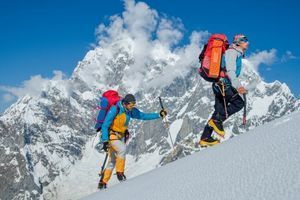
Every year, as August 8 approaches, mountain enthusiasts congratulate one another on social media on Mountaineering Day.
In reality, however, this date simply commemorates the first ascent of Mont Blanc in 1786.
If there is one date that truly deserves to be called the birth of mountaineering as a sport, it is July 14, 1865—the day the Matterhorn was climbed for the very first time.
Why the Matterhorn?
Not the highest mountain—the hardest one.
The first ascent of the Matterhorn wasn't significant because it was the highest peak in the Alps.
Quite the opposite. Climbers deliberately chose the most technically challenging mountain.
This marked the beginning of true climbing—where the goal was no longer simply to reach the summit, but to overcome the greatest technical challenge.
That philosophy shaped mountaineering for more than 150 years. From then on, the ultimate objective became not the highest mountain, but the most demanding route.
Great ascents are never accidental
The first successful expedition was led by British mountaineer Edward Whymper.
Before finally reaching the summit, he spent almost ten years returning to the Matterhorn, trying to find a viable route.
And he certainly wasn't the only one.
The community of early alpinists was remarkably small. They knew one another, climbed together, exchanged ideas, competed, and kept returning to the mountain year after year.
The Matterhorn proved a lesson that still holds true today: mountaineering begins with preparation.
The first great rivalry in mountaineering
In 1865, the Matterhorn became the stage for one of the first great races in climbing history.
Who would reach the summit first?
The story had everything: competition, strategy, deception, friendship, teamwork, and an overwhelming desire to be first.
Whymper's team made history by climbing via Switzerland's Hörnli Ridge. Just a few days later, another party reached the summit via Italy's Lion Ridge.
It was here that competition became an integral part of mountaineering as a sport.
The tragedy that changed the rules
The story of the first ascent ended in tragedy.
During the descent, one climber slipped. The old rope connecting part of the team snapped, sending four climbers to their deaths down the north face.
The accident became a turning point in mountaineering history.
It prompted climbers to rethink equipment, rope quality, belaying techniques, team organization, and expedition planning.
Ernest Hemingway famously wrote that there are only three true sports—bullfighting, motor racing, and mountaineering—while everything else is merely a game. On mountains like the Matterhorn, the price of a mistake can indeed be fatal.
The lessons learned from this tragedy laid the foundations for modern mountaineering safety standards.
Instead of congratulations
That's why we won't be wishing you a "Happy Mountaineering Day."
Instead, we wish you something far more important: safe, successful ascents—and safe returns home.
And if the Matterhorn is on your bucket list, our advice is simple: study the route carefully, arrive well prepared physically and technically, or hire a professional mountain guide. There are even experienced Ukrainian guides who regularly work on the Matterhorn.
If you haven't yet explored the story of the first ascent, we highly recommend it. It remains one of the most fascinating—and instructive—chapters in mountaineering history. There's even a feature film from 1938 about the expedition, available on YouTube.
One Last Thing
The Matterhorn is more than just Toblerone.
The iconic silhouette on our MyPeak 20L backpack isn't simply a beautiful mountain.
It's a tribute to the peak that changed the history of mountaineering forever.
And as for August 8 and why it's celebrated as Mountaineering Day—we'll save that story for another article.