The story of our softshell clothing began back in 2015.
At the time, we moved to the Czech Republic for a couple of years. And that was where we noticed how popular clothing was in Europe that worked equally well outdoors and in the city.
Comfortable, close-fitting and functional — but without looking like traditional outdoor gear. It doesn't hang like a sack, doesn't restrict movement and still looks perfectly appropriate when you need to head into the city after a day in the mountains.
We liked the idea.
That is how the first FRAM softshell jackets and pants came to life.
The pants came first
With the pants, things came together pretty quickly.
They became the next generation of our black "self-dumping" pants — a model that at the time was particularly popular among outdoor moms looking for something suitable for an active urban lifestyle.
Softshell was a perfect fit for the concept: a matte, stretchy fabric that doesn't shine, follows the shape of the body and at the same time provides protection from wind and precipitation.
The "self-dumping" construction had another advantage. You could put the pants on over other layers without taking off your shoes. And the side zippers could be opened for quick ventilation during active movement.
But we needed to find out how well they worked beyond the city.
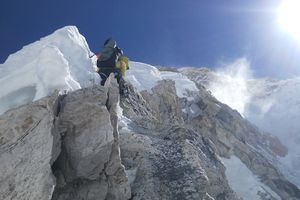
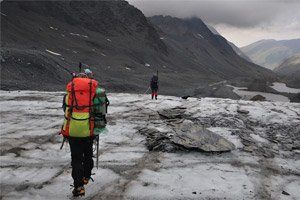
So we took them on an expedition to the Pamirs.
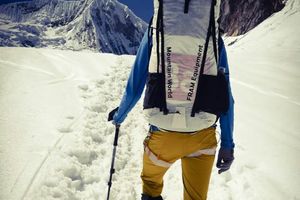
At around −20 °C, we traversed a 7,495-meter peak wearing them.
Test passed.
The model was named Garmo, after the glacier of the same name in the Pamirs.
With the jackets, we got a little lost
If the concept for the pants came together quickly, the jackets were a different story. We decided not to limit ourselves to a single idea.
Instead, we launched three models at once.
Vir — a softshell jacket with a fleece lining.
The key feature was the cut. We wanted the jacket to stay in place when climbing with your arms raised instead of riding up.
The name Vir came from an ice-climbing formation in the Czech Republic where we used to climb with our friends.
Dynamics — the same concept, but without the fleece lining.
Soft, stretchy and almost like a lightweight membrane jacket — only much more pleasant to the touch. And, of course, in an elegant black.
Both models were designed specifically for sports: a helmet-compatible hood, a cut designed for climbing with raised arms, and chest pockets only, so lower pockets wouldn't interfere with a harness system.
Crokus — and this was a completely different story.
It was our first dedicated women's softshell jacket, with a fitted cut.
The idea was primarily "city +": the functionality of outdoor clothing with a look that also works comfortably in the city.
All three models sold well and found their own fans.
But it was around this time that we discovered another property of softshell that would strongly influence the development of our future models.
It is fantastic for branding.
From our own models to team jackets
We learned how to bring bright custom-colored softshell fabrics to Ukraine.
And pretty quickly realized that this opened up completely new possibilities.
That's how we started making jackets for teams.
The first were Ukrainian ice climbers — Valentyn Sypavin and Vika Holub.
At the time, Valentyn became a World Vice-Champion, while Vika became a European Junior Champion.
Following Valentyn's feedback, we redesigned the jacket once again.
A simpler hood.
Lower pockets.
And, as Valentyn put it, — "for sunflower seeds."
That was how the Ice-C model was born.
It gradually replaced the previous generation of jackets and became one of our most recognizable models.
The highest-altitude "pajamas"
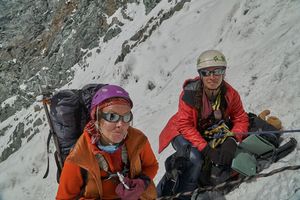
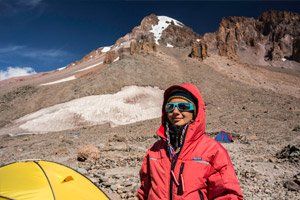
At some point, Ice-C turned into something of the highest-altitude "pajamas" for Ukrainian expeditions.
At altitude, it worked as a deep mid-layer.
Lower down, it served as comfortable outerwear.
It turned out to be a very practical solution for expeditions: one jacket could work in different conditions, while every six months we could create individual colors and designs for a new team.
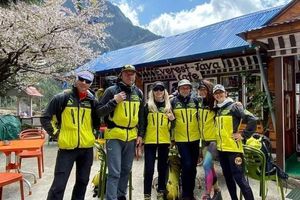
There was a season when our softshell jackets were simultaneously climbing Everest, Manaslu, Ama Dablam and Cho Oyu.
For us, this was one of the best possible gear tests: not a laboratory, but real mountains and people who rely on their equipment every day.
A new generation of softshell
Meanwhile, we found a supplier who could produce softshell for us in custom colors with 18,000 / 12,000 specifications.
This was the next stage.
The new fabric was significantly softer, allowing us to make the jackets more comfortable and versatile.
That's how Sun — bright yellow jackets — and Night — understated black models — appeared.
Both were made in men's and women's versions.
But over time, we realized that not everyone needed a highly technical sports jacket.
The market needed a simpler, reliable and more affordable utility version.
Bear and Ursus
That's how Bear was born.
A classic arms-down cut, smaller pockets, a simpler hood and a practical Coyote color.
We paired the jacket with Ursus self-dumping pants — featuring knee pockets that can accommodate foam inserts when needed.
This version became particularly popular among military personnel and volunteers.
And now a women's version is joining the line — Bera.
Why we still love softshell
Over the years, we have made many different softshell models.
We've changed the cuts, fabrics, colors, pockets and hoods. We've tested them in the city, during training, in the mountains and at high altitude.
And we think that's exactly where the main advantage of softshell lies.
It's clothing that doesn't force you to choose between comfort and functionality.
In summer, it can provide light insulation and rain protection.
In winter, it can be an outer layer for active movement.
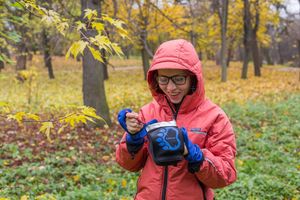
In the city, it's simply comfortable clothing that doesn't look like technical gear.
And when needed, the same jacket can make the journey from a city walk to a high-altitude expedition.
That's why we continue to develop softshell and why we still love this material.
Do you wear softshell? What qualities do you value most?